

Google Ads IP exclusions can be bypassed. We did it.
What Google Ads advertisers should know about IP addresses used in fraud strategies Google Ads IP exclusions can be bypassed. We did it. TL;DR —
What Google Ads advertisers should know about IP addresses used in fraud strategies
TL;DR — We reproduced end-to-end, on our own Fáktica Google Ads account in March 2026, a technique that lets an attacker keep generating charged clicks from an IP the advertiser has already added to Google Ads’ exclusion list. On top of that, we are already documenting two fingerprints consistent with this technique on client accounts: clicks from excluded IPs that Google keeps charging, and the same GCLID reused across multiple IPs and machines. Until Google addresses it server-side, IP exclusions and every third-party tool built on top of them offer weaker protection than advertisers assume.
TL;DR — We reproduced end-to-end, on our own Fáktica Google Ads account in March 2026, a technique that lets an attacker keep generating charged clicks from an IP the advertiser has already added to Google Ads’ exclusion list. On top of that, we are already documenting two fingerprints consistent with this technique on client accounts: clicks from excluded IPs that Google keeps charging, and the same GCLID reused across multiple IPs and machines. Until Google addresses it server-side, IP exclusions and every third-party tool built on top of them offer weaker protection than advertisers assume.
IP exclusion lists are one of the few native tools advertisers have to block known fraudulent sources. Even in the best case they are a weak defence — we’ve written elsewhere about how dynamic IPs and CG-NAT already erode their effectiveness, and why we only recommend them as a last resort. What we are documenting here is different: a technique that doesn’t just erode IP exclusions, it bypasses them entirely. We call it IP Exclusion Bypass via Link Harvesting.
The attack uses two IPs with distinct roles:
The setup is the usual fraud pattern: the attacker generates clicks from an IP, the advertiser detects them and adds the IP to the exclusion list. That IP is now the exposed IP. Nothing new so far. The novel part — the bypass itself — is what happens next:
The net result: the exclusion list becomes ineffective. The exposed IP keeps producing charged clicks; the hidden IP stays permanently invisible to the advertiser.
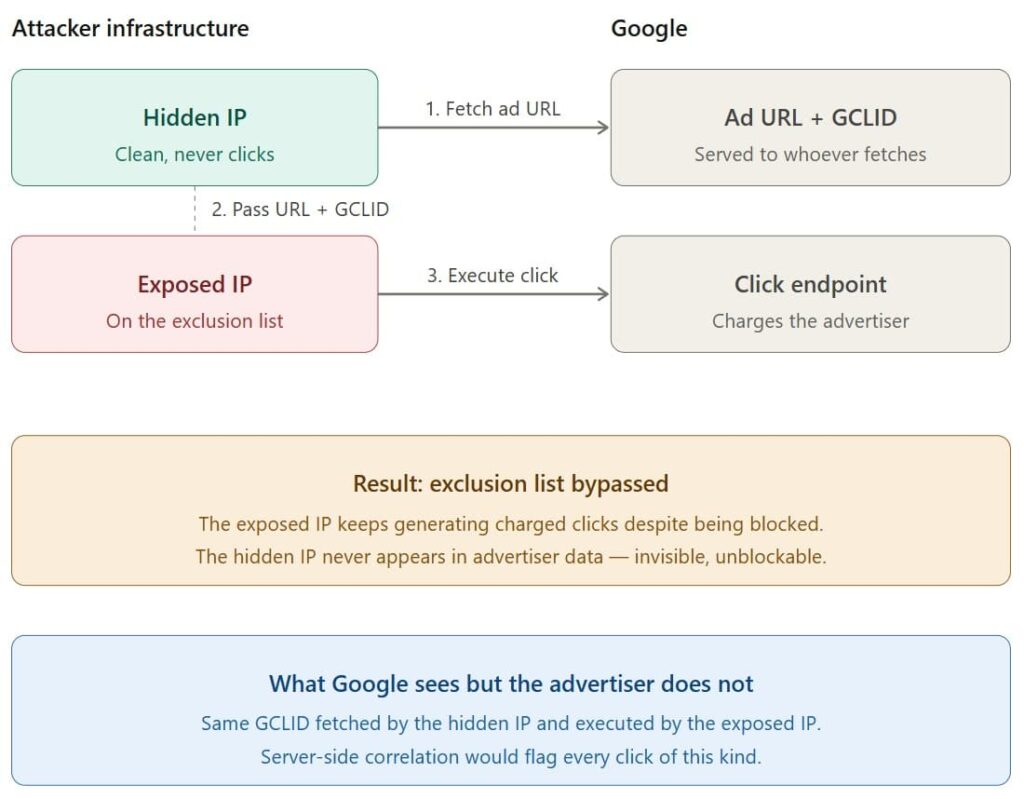
In March 2026 we reproduced the full attack in a controlled proof-of-concept (PoC) on our own Fáktica Google Ads account, simulating an attacker against our own campaigns. We successfully generated charged clicks from an IP that was on our exclusion list, exactly as described above. The experiment is internally documented and fully reproducible.
This is not a theoretical curiosity. In ongoing forensic work on client accounts, we are observing behaviour fully consistent with this technique being actively exploited — in two different ways.
The first is the smoking gun: clicks from excluded IPs that Google keeps charging. We have documented cases of single IPs that accumulated thousands of clicks over almost two years, with tens of clicks per day, fitting every textbook pattern of automated fraud. Also coordinated botnets of IPs cycling through the same set of user-agents, day after day. When advertisers add those IPs to their exclusion lists, what happens is not that the clicks stop — what happens is that Google invalidates some of the subsequent clicks from those IPs, but charges for others. An excluded IP that keeps producing charged clicks is, by definition, bypassing the exclusion mechanism.
The second is GCLID replay patterns — single ad URLs (each with a unique GCLID) appearing in request logs from multiple distinct IPs, often in different countries, within short windows. That is precisely the fingerprint the harvest-and-replay technique produces: one capture, multiple executions. It is also one of the plausible explanations for the same GCLID being charged twice, a pattern we have covered separately.
We cannot confirm from the advertiser side that the specific mechanism is always the one described here — we do not have access to Google’s server logs. But the fingerprint is there, it is consistent, and it is not rare.
The implication is structural:
Google is in a unique position to close this. When a user clicks a Google Ads ad, the ad URL is not the final destination — it is a Google redirect that acts as a bridge to the advertiser’s landing page. The advertiser has no visibility into the hidden IP, but Google does: Google sees the IP that fetched the ad URL and the IP that ultimately executed the click, and both requests share the same click ID (GCLID).
Correlating those two IPs is a server-side operation. Google could flag or invalidate any click whose GCLID was harvested from a different IP than the one executing it, or — at a minimum — treat clicks coming from IPs on the advertiser’s own exclusion list as invalid regardless of which IP originally fetched the URL. Neither is technically hard. Neither requires any new signal that Google does not already collect.
We have reported this to Google on several occasions, on behalf of clients suffering substantial six- and seven-figure losses from attacks that show this exact fingerprint. To date, nothing we can observe from the advertiser side has changed, and the technique continues to work.
This is not the first time this kind of issue has been publicly raised. More than a decade ago, Prof. Manuel Blázquez (Universidad Complutense de Madrid) documented a related vulnerability in Google AdSense — a different exploit (publisher-side, not advertiser-side) but with a structurally identical core: extract the validated ad URL through one channel, execute the click from another, exploit the fact that Google sees both sides while the victim sees only one. Blázquez reported it to Google in 2013, got no substantive response, and published. More than ten years later, we are publishing a variant of the same structural problem, still unpatched.
Honestly, unilaterally, not much — the information needed to definitively detect this attack lives on Google’s servers, not yours. But there is a concrete first step worth taking:
If you want to understand the broader attack surface we are seeing across Google Ads — impression fraud, duplicate-GCLID billing, toxic YouTube placements — the rest of this blog is the place to start. And if you suspect you are being targeted and want an independent forensic audit of your traffic, that is exactly the work we do
What Google Ads advertisers should know about IP addresses used in fraud strategies Google Ads IP exclusions can be bypassed. We did it. TL;DR —

What Google Ads advertisers should know about duplicate GCLIDs and charges arising from invalid impressions What Google Ads advertisers should know about duplicate GCLIDs and

12.015 IMPRESSIONS, 0 CLICKS 12.015 IMPRESSIONS, 0 CLICKS A search campaign with Ad Relevance “Above Average,” a 48% Absolute Top rate, and a 95% Search